Ever since its invention in 1959, the three-point seat belt is estimated to have saved over a million lives. Keeping passenger safety paramount, the UAE made seat belts mandatory for all passengers since July 1, 2017 with a penalty of 400 dirhams and four black points on the driver’s license. While the adherence figures are largely encouraging, the recent survey results from ‘Road Safety UAE’ (in partnership with Al Wathba Insurance) points to the fact that there is still a long way to go before the compliance is total.
The available figures from accidents offer compelling statistics for strict adherence to the rule. Abu Dhabi Police shares vital info that 60% of fatalities in the Emirate of Abu Dhabi happen due to non-use of seat belts. Perspective-sake, the number stands at 49% in the US, 25% in the UK and 25% – 50% in the European Union.
Awareness of seat belt safety
The first step to extend that hand for the seat belt begins with acceptance of its safety potential. Even so, does the awareness and acceptance always translate to usage compliance? Well, the numbers from the survey speak for themselves:
KNOWLEDGE
- ‘Seat belts protect drivers and front passenger’ – 95% agree
- ‘Seat belts protect rear seat passengers’ – 82% agree
USAGE
Drivers who always use seat belt – 86%
Front seat passengers who always use seat belt – 86%
Back seat passengers who always use seat belt – 24%
Drivers who always ask passengers to buckle up – 70%
If you know why, then why not?
While 86% could seem like a high number, it fades in contrast with the 95% who agree with the protective powers of the seat belt. Of course, ‘always’ could be the keyword that pull down the figures drastically. Perhaps many of them do wear seat belts in many instances (5% say often and 5% say sometimes) but the alarming fact here is that safety is made a random choice – showing a possible lack of seriousness towards the topic. The share of rear seat passengers who always use seat belts is nothing short of alarming! On the other hand, there is an encouraging display of responsibility among drivers who remind their passengers to buckle up – 70% say always and 14% more do it ‘often’, as per the survey. Incidentally, the rear seat belt reminders in new cars should soon be making lives easier for more drivers!
With a rather high percentage that agree to the safety extended by the seat belt, it is ironic that reasons seem to be many for not wearing a seat belt – some would even be amusing, if the topic weren’t safety!
‘The rear seats feel safe enough without it’ – 55%
‘Don’t see the need on short trips’ – 27%
‘Airbags protect just as well as seat belts’ – 16%
‘(The one driving the car) is a safe driver, and hence there is no need for seat belts’ – 10%
The third one is a good instance of ignorance – airbags work best when seat belts are engaged – and as for the fourth one, I reserve my comments! (Looking forward to your comments and observations in the comment section below.)
Improving seat belt compliance in the UAE
Studies prove that seat belts reduce fatalities in vehicle accidents by 45% – 60%, depending on the type of vehicle and the type of impact. For children, this value reaches up to 80%!
Thomas Edelmann, Managing Director of RoadSafetyUAE, underlines the need to increase seat belt wearing rates: “…this is the single biggest opportunity we have in order to reduce the number of fatalities on UAE’s roads! The focus must be on generating and publishing up-to-date figures about fatalities and injuries linked to on-wearing seat belts, strong awareness initiatives are needed, as well as ever increasing enforcement efforts by means of sophisticated radar installations and utilizing AI.”
Road Safety UAE informs that the survey was conducted in January 2026 based on a representative sample of 1010 UAE residents. More information can be had at roadsafetyuae
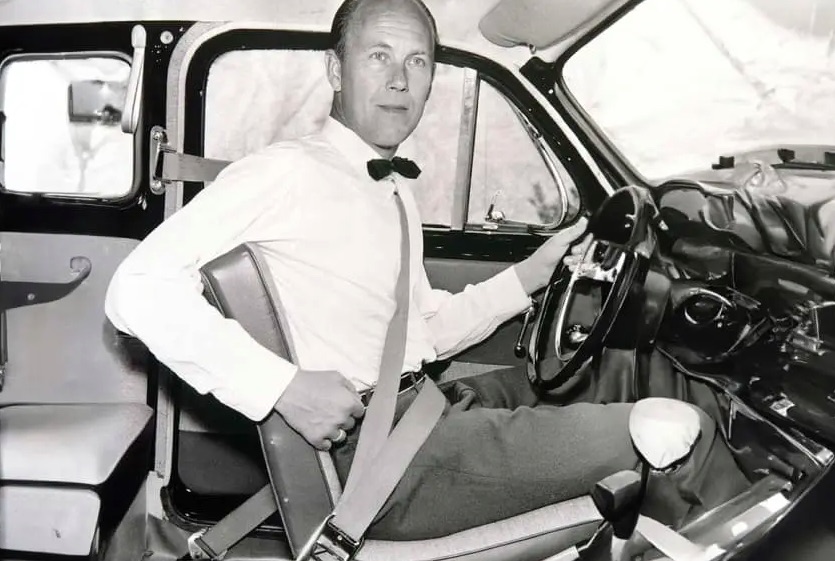
Nils Bohlin, the inventor of 3-point seat built
The three-point seat belt – a selfless tale of safety
Seat belts are part of mandatory safety regulations in vehicles in almost every country. Invented in 1959 by Nils Bohlin, a Swedish engineer, on behalf of Volvo, it has been a lifesaver ever since. While Volvo patented this invention, this was also perhaps the greatest example of selflessness in the automotive market-place – the patent was released allowing all automobile manufacturers to install seat belts in their vehicles upholding the principle – safety first; profits next.
But why did I say ‘almost every country’ at the start – well, did you know that Monaco, for instance, doesn’t insist on seat belts thanks to low urban speed limit? So do some other countries exempt some categories or circumstances, like parking.
Before the three-point seat belt, and after
Before the 3-point seat belt was thought up, some cars had a two-point seatbelt, like those in airplanes, that was worn across the waist, leaving the torso unsecured. Thrown forward in an accident, this could cause serious injuries to the head, neck and abdomen. In fact, in some high-speed collisions, this half-hold solution could even be cause of damage.
The 3-point anchor design, that combined a lap belt with a diagonal strap across the torso, was better at distributing the force of an impact across the occupant’s body.
More information can be gathered at https://gsbelts.com/how-volvo-patented-the-seat-belt-to-save-millions-of-lives/